
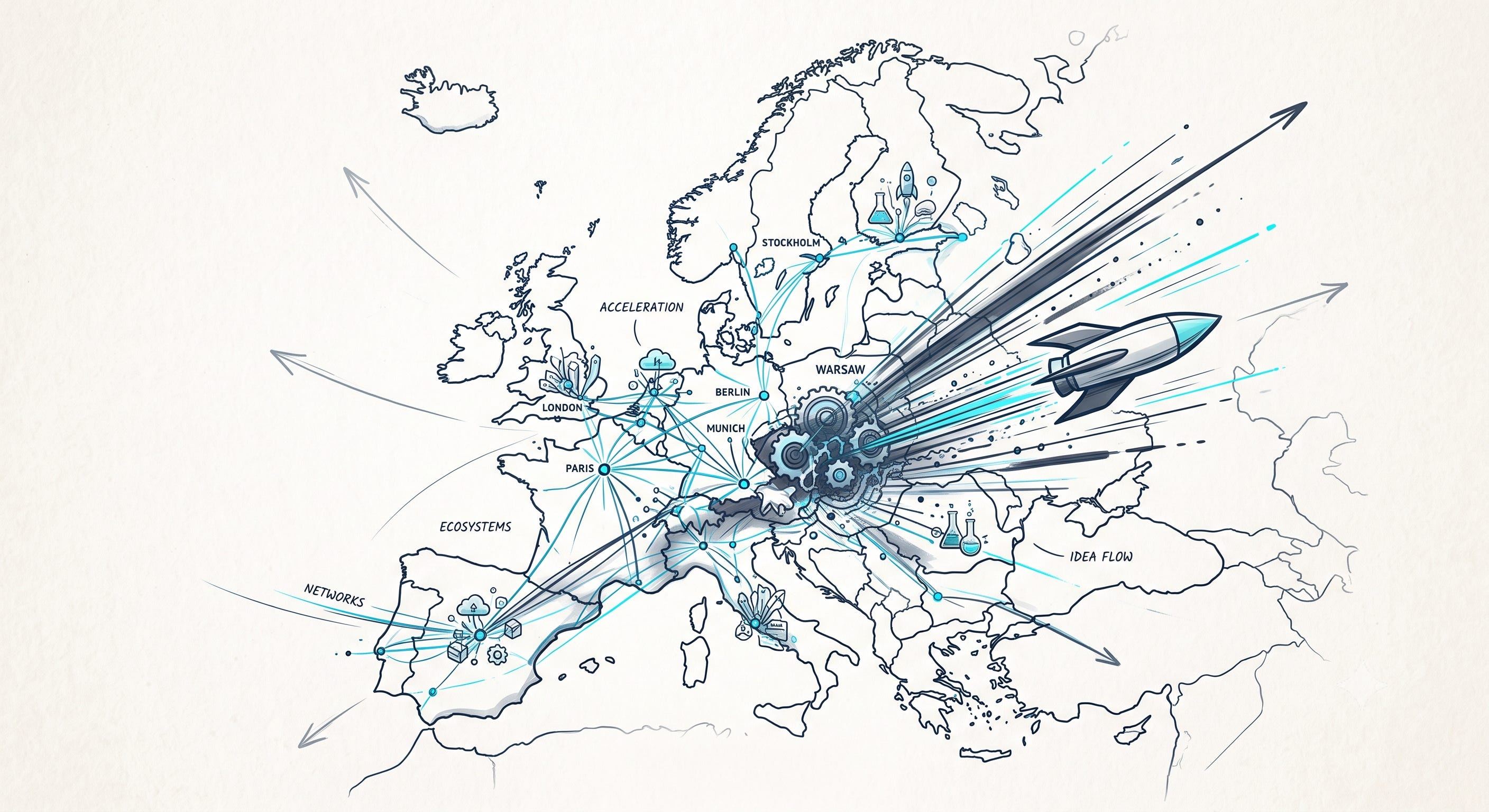
A strong Europe needs strong companies
Notes from the age of sand. What my master's thesis in economics got right about the digital economy, and wrong about Europe
Between late 1999 and the first half of 2000, I wrote 115 pages for my thesis as the final part of obtaining my MSc in Economics at Erasmus University Rotterdam. In it I argued that the digital economy would run on different rules than the industrial one, and that Europe was going to have a unique opportunity. I got the rules right. I got Europe wrong.
As I start writing Augmented Ideas, I want to use some of the building blocks I researched a quarter of a century ago. The framework I used then lifts cleanly onto today, which is part of this newsletter’s raison d’être.
It starts with how information stopped being analogue and became digital.
[THESIS 1999, Chapter 3]
In the digital economy, information can be completely digitized into bits. Data, text, audio, and video can be digitized into files, which use multimedia technologies for its creation, storage, and use. This is the essential difference between the digital economy and the industrial economy, in which information follows an analog or physical form. It is the difference between the physical world and the virtual world.
Furthermore, network technologies create the possibility of exchanging these digital files around the world at the speed of light. The fundamental transformation of the form and speed at which information behaves and travels is the core engine behind the contemporary digital revolution.
The framework was not all mine. Don Tapscott coined the term digital economy and his Blueprint to the Digital Economy shaped a good deal of what follows. The thesis also stood on other shoulders such as Carl Shapiro and Hal Varian‘s Information Rules for the network economics; Larry Downes and Chunka Mui‘s Unleashing the Killer App; and Michael Porter and Ronald Coase for the industrial-economy foundations. Where I quote my own text below, the ideas underneath it are often theirs.
In 1999, I described three waves:
[THESIS 1999, Chapter 3]
The first wave : centralized computing in the mainframe era
The second wave : distributed computing in the PC era
The third wave : networked computing in the virtual era
We are only at the beginning of the third wave, because there is still a long way to go before the digitalization and immediacy of information is complete.
I still like this paragraph about the first wave.
[THESIS 1999, Chapter 3]
The invention of the silicon microchip in 1958 spurred off the first wave of the IT. At that time, it was hard to believe that the existence of a miniature integrated circuit, which consisted primarily of sand, would have such a large effect on society. With the silicon chip, the absence or presence of a charge on a particle represented the 1 and 0. The microprocessor chip could do the work of a set of vacuum tubes that would fill a large building and require its own electric generating plant.
Furthermore, the following decades saw such exponential improvements in the processing power of the microchip and miniaturization that a simple greeting card that sings happy birthday which you buy in the store today has more computing capacity than the 1947 ENIAC computer. After history had witnessed the age of iron, bronze, and steel, the new age of sand had arrived.
The structural point I was making about the first wave was the concentration of authority that delivered the hardware.
[THESIS 1999, Chapter 3]
From the 1950’s to the 1970’s, technological infrastructure was characterized by large mainframe systems with closed proprietary architectures. These were large central supercomputers, which ran on a specific operating system, which was owned by manufacturers such as IBM and Digital Equipment Corporation. They worked according to a master/slave relationship concept that provided centralized rather than distributed computing.
Mainframe systems would support thousands of users who were attached to the mainframe through “slave” or green terminals. All transactions and tasks from a particular day would be processed in large batches during the night.
And the second wave reversed that authority, handing it to the end user.
[THESIS 1999, Chapter 3]
The tremendous improvements of the microprocessor led to the PC (Personal Computer) which has enough processing power to carry out multi-tasks that could previously only be carried out on a mainframe supercomputer. This in turn signified the end of the master/slave concept and the beginning of the client/server concept, which became the standard corporate computing architecture in the early nineties. The shift from a master/slave to a client/server system automatically meant a shift from centralized computing to distributed computing.
In the thesis I also mapped the emerging digital economy as four layers, adapted from a framework Cisco Systems had developed: Internet infrastructure, applications, infomediary, commerce. That still holds up as a foundation for the research journey I am starting now. The logic was that value would move up the stack over time.
“The four layers can, therefore, be seen as an evolution path which the digital economy is following. First, we see the infrastructure players delivering the most value as there is initial demand for hardware that facilitates actual economic activity in the digital economy. Afterwards, the industries turn from technology-driven places to market-driven places.” James Loudon, 1999
I also described a firm type that did not really exist yet.
[THESIS 1999, Chapter 4]
The Application Service Provider is a firm that delivers its applications over the Internet. Users can easily collect and update information from their applications via a simple interface on any platform that they may be using.
[...] ASP services offer customers access to a new application environment without making up-front investments in the application licenses, servers, people, and other resources.
That is software as a service, described a decade before the term existed. Forrester thought the market would be worth $6.4 billion by 2001. The category it became is worth a great deal more than that. Almost none of it is European.
I got the winner-take-all mechanics right too, standing on Shapiro and Varian's shoulders.
[THESIS 1999, Chapter 3]
This simply put, is the situation where the strong get stronger, and the weak get weaker. In its most extreme form, a winner-take-all market emerges in which a single technology or firm eliminates all others.
Are we experiencing déjà vu? Commoditisation is moving up the stack again. The AI infrastructure is being built first. Today’s and tomorrow’s unicorns are building the application layer, and data, IP and relevant context is the new gold.
What I got wrong, and it is the same thing Europe got wrong
Wrong call #1: the wireless advantage.
[THESIS 1999, Chapter 4]
The Wireless Advantage of Europe
GSM (Global Standard for Mobile) is in fact becoming the global standard. A Forrester Research survey carried out in 1998 among European Internet users showed that telecom de-regulation was perceived to be the major factor driving Internet growth at the beginning of 1998. The fact that GSM originated in Europe gives it a wireless head start over the US, which implies that European adoption of the Internet, could proceed at a faster rate than seen in the US.
In 1984, the European Commission initially established the Global Standard for Mobile (GSM). Their objective was to create a strong European standard in digital phone telephony in order to be able to cope with strong future demand in mobile phones. This objective was achieved.
[...] The standard has already delivered huge benefits to the Scandinavian markets with Ericsson, a Swedish telecom firm, and Nokia, a Finnish telecom firm, being two of the three largest firms to supply digital mobile telephony.
The PC, seen to be the stifling issue where Europe lagged behind the USA, will therefore no longer have to be rendered as the most important platform for Internet. The rapid growth in wireless infrastructure in Europe providing another platform for web access which Europe can wield in order to achieve similar growth effects that the digital economy has done for the US in the past decade.
Every fact in that passage was correct. A European Commission standard from 1984 became the global standard. Two of the three largest handset suppliers were European. Europe owned the pipe.
Eight years later the iPhone arrived, and the platform wars of the 2010s were fought between iOS and Android. Nokia’s own CEO called his company a burning platform in 2011. Both Nokia and Ericsson are doing well today, but as network equipment businesses. They retreated back down to the infrastructure layer.
Wrong call #2: the infomediary
Here is my own definition of the third layer:
[THESIS 1999, Chapter 4]
Infomediary (Hagel III, J.H. and Rayport, J.F.): a business whose sole or main source of revenue derives from capturing consumer information and developing detailed profiles of individual customers for use by selected third-party vendors.
[...] The infomediary does not directly generate its revenues from selling products or services, but has based its web-enabled business model on revenues generated from advertising, membership subscription fees, and commissions.
That is a description of Google and Meta, written before either existed.
And here is what I concluded about it:
[THESIS 1999, Chapter 7]
Despite the great potentiality of this proposition, the infomediary is not the epicenter of value. For it only matches two existing forces – the explicit need of the customer and the explicit offering of the supplier.
I named the layer where essentially all of the value would settle, defined it accurately, and then told the reader to look one floor higher. I thought the money would end up with the creators. I called it the economy of ideas. It did not go there. It went to the platforms that scaled the users.
Wrong call #3: the portals.
[THESIS 1999, Chapter 4]
The above-mentioned US firms are dominant in this area at the moment; however, European firms have opportunities to sustain positions on their own continent. With the exception of Yahoo!, the large portals have had difficulties in rolling out their operations with the same success in Europe as they had in the US.
The European names I listed as contenders in that layer were World Online, Chello, T-Online, Wanadoo and Virgin Net. None of them holds a meaningful position in that layer today.
Europe won the infrastructure layer. Europe was competitive in the applications layer for a while, but lost the infomediary layer completely, and the commerce layer along with it.
And my own thesis explains why, in a paragraph I wrote about telecoms without realising what I was describing.
[THESIS 1999, Chapter 4]
The reason why massive firms are being formed through these alliances, mergers, and joint ventures to provide the infrastructure of the digital economy, is in fact, because this layer is in itself purely industrial. The wires, fiber-optical cables and routing and switching equipment are all physical elements of the Internet. Therefore, supply-side economics still reign strategy in this area with the supply-side economies of scale explaining why there is a huge concentration on a global scale in this layer.
That is the real conclusion. The infrastructure layer runs on supply-side economics, and Europe is very good at supply-side economics. It has been doing industrial scale for two hundred years.
The problem for Europe was demand-side economics.
[THESIS 1999, Chapter 3]
In the industrial economy, a firm achieved efficient production by expanding to the point that it could profit from supply-side economies of scale. In the digital economy, the economics of networks, or demand-side economies of scale, requires the firm to assemble a critical mass in customer base for sustainable business.
Demand-side economics need a single addressable market to reach the knee of the curve fast enough to win. The United States has one. China built one. Europe has one on paper. In practice it behaves like twenty-seven.
(Source: The Hockey Stick Principles, Flatiron Books)
The knee of the curve is where critical mass is reached. Getting there requires one market, not twenty-seven.
Jacques Delors told the European Parliament in 1989:
“Europe’s diversity makes it prodigiously rich. This diversity must be preserved, so that it can bear fruit for the common good.”
He was right. Europe's diversity is unique and core to the European project. But on a balance sheet it is an intangible asset that does not always pay out, while the fragmentation of the market is a cost we have never managed to reduce.
Mario Draghi diagnosed Europe’s problem most effectively with ‘The future of European competitiveness‘ in September 2024. It matters especially for the AI wave we are now in, where the whole stack is being rebuilt from the bottom, starting with compute and energy. The models are made in the USA and in China. There is an application layer and an agent layer being developed, and data and content being leveraged on top of them.
Is Europe’s reflex once again supply-side?
Draghi’s practical prescription goes beyond supply-side measures: Europe should accelerate AI adoption in productive industrial sectors where it has strong assets, such as industrial data, domain expertise, established customers and operational use cases. The strategic priority is to build global strength in sector-specific, industrial AI, while investing enough in European compute, cloud and secure data infrastructure to reduce critical dependencies and retain control over sensitive capabilities.
Hockey stick growth cannot happen where there is too much bureaucracy in the way. If Europe does not get this wave right, then fears of becoming a vassal state could be a reality by 2040.
Europe is good at football. The risk is that in geopolitics and the AI race, it becomes the ball.
To business leaders who believe Europe’s coordination machinery is still structurally too slow for this moment, I would say, don’t wait for the silver bullet to be presented. There is a lot you can do in your direct surroundings by coordinating with other companies and institutions.
As an ardent networker, I’d advocate the use of commercial ecosystems and communities that are iterative, imperfect yet constantly moving forward to test ideas, try new ventures, combine to offer capabilities none of them could fund alone.
Community building is the exchange between people to align, challenge, and validate ideas. Commercial ecosystems are when the talking stops, innovative services start being rendered, and partnerships get formed. For companies to be strong, they have to remain competitive. To remain competitive you need to innovate, but you can’t do all of that in-house, which is why partnerships become essential.
This makes a difference as the technology race widens the gap between the fast movers and endlessly aligning incumbent players. Clayton Christensen’s The Innovator’s Dilemma: When New Technologies Cause Great Firms to Fail has long captured this challenge.
We could take a page from the Chinese approach here.
“When I worked at BASF, we often believed products shouldn’t leave the factory until they were 110% perfect. China teaches a different lesson: sometimes 80% is enough because speed matters. You can improve the product later. That mindset has become one of China’s biggest competitive advantages.” Joerg Wuttke, 2026 interview with AmCham China’s magazine
First of all, I am a Europeanist. Secondly, I am a globalist. My concern, interest, and focus sit around the state and evolution of European competitiveness, and how AI innovation and industrial policy play into it, along with the external forces pressing on all of it.
A strong Europe needs strong companies. Augmented Ideas will be a wide-angle newsletter that explores how European companies can accelerate innovation and transformation. I will be experimenting and iterating with this newsletter as I go along.
I do not pretend to have the answers, but with the ongoing conversations that I have with executives regularly on an “off the record” and Chatham House Rule basis, I’ll use Augmented Ideas as my thinking pad to document and structure what’s cooking beneath the surface in Europe. Same mantra applies here: this is far from perfect, and I’m not waiting until it leaves the factory gate.


