



I have spent the last 20 years selling business information to executives at multinational companies. Not data, not news, but a structured kind of insight that companies pay for to underwrite decision making. Most of it was focused in China, on China, and the insight was delivered through reports, presentations and CEO roundtables.
Early on I developed a private framework for it which I call the unit economics of information. The unit economics of information looks to place each “insight” business onto a single spectrum. On one end, there is mass-formatted B2C media and on the other, fully bespoke consulting. A product’s position is determined by how many buyers share the same deliverable.
On the B2C media side the price is somewhere between 0 and 2 digits, but the quantity can be 5, 6, 7, 8, even 9 digits. Beyond that you are into hyperscaler territory anyway so that’s beyond scope of this article. Let’s flip to the other side. Take the local office of a global consulting network, or a boutique firm, and it runs the other way around. They might have 10 or 20 clients, maybe 100, but the projects go from 5 to 7 digits.

(Photo credit: Felicia Buitenwerf on Unsplash)
On the B2C side, format is everything. Facebook is blue. The Economist is red. The 8 o’clock news starts at 8 o’clock and does not start five minutes late (just like any other primetime TV show). On the consulting side, the work is highly specified and fully bespoke, and largely format-agnostic. You can present in PowerPoint or Prezi and nobody cares; you can arrive 15 minutes late to a meeting which is not ideal but it’s not a show stopper. What matters is that the project is delivered to spec. There are no contracts on the B2C side either. You click on the app store, you buy the paper at the kiosk, you tune in to your TV to watch a live performance or binge on a streamer. With consulting, the contract specifies the deliverables.
I wanted to set out the context to zoom in on the middle of the spectrum, a space where I have worked from 2007-2026: structured B2B insight delivered and sold by way of memberships and subscriptions. The buyer is an enterprise business user, format is predictable, which is what makes the economics work from the delivery side too, but the experience should be designed to feel bespoke. I’ve always thought of it as the bento box. You know the compartments, you trust the quality, and you can go a la carte later if you want more.
What determines a product’s position on this spectrum is the level of syndication: how many buyers share the same deliverable. One buyer for one unique stream of deliverables and on the bespoke consulting end of the spectrum. One million buyers or more and you are at the B2C media end of the spectrum. The middle ground I’ve been used to playing in is where you have 40 buyers of a product that is 20,000 EUR per year. Those clients get a deliverable that can be specified on one A4. Both the receiver and the renderer of the services benefit from the falling unit economics that syndication brings about.
If I have lost you, here is an example. Say you want ideas about how to move your career forward. You are 35. You can pick up your favourite outlet and read a columnist who writes about careers, or follow someone on Instagram who does the same. They deliver in a fixed format, one to many. It might help a little, but not much, because they do not know you or what you need. The next level up is the space in the middle: you join a programme, a set number of sessions, with one coach or with twenty other people in the room, for a one-off fee, a subscription or a membership. And all the way at the bespoke end is a personal coach whose entire job is you.
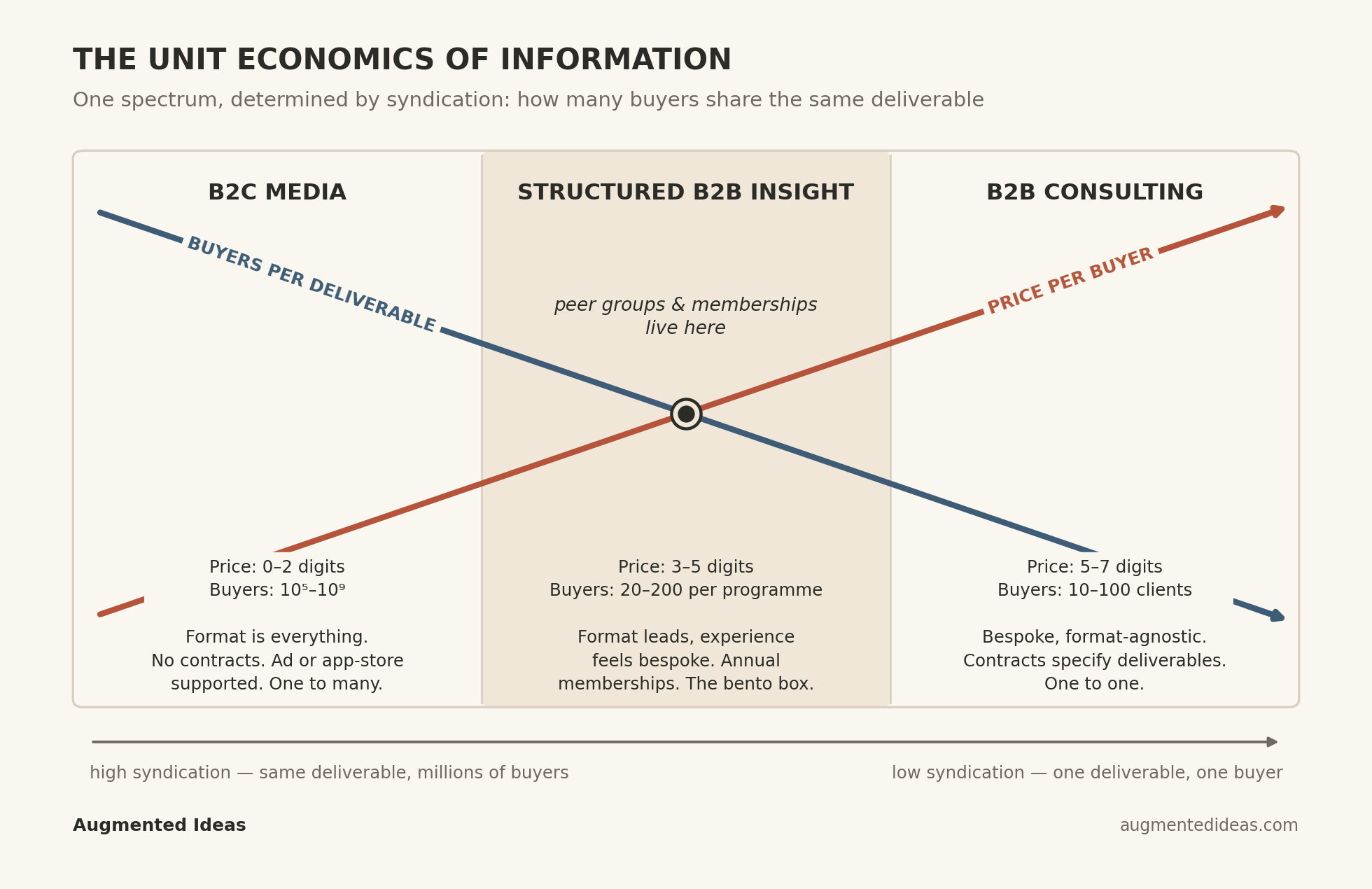
(Source: Chart generated with Claude)
Where executive programmes sit
Now take the product I know best, the one I have built and sold for years: the facilitated executive programmes, whether P&L owners or a function-specific cohort, meet on a regular basis under the Chatham House rule, working through problems with peers who genuinely relate to them and can offer contextualised advice.
Here the price is 4 or 5 digits. The quantity usually runs between 20 and 200, depending on whether it is a tight peer group or a larger forum. The service comes with predictable parameters: you get X meetings a year, Y calls with the analyst, Z number of reports per month/per quarter etc. The business owner determines the deliverables which have to meet a product-market fit.
In this business, a good deal of effort does go into understanding each member and ensuring a high quality and consistent experience. A good executive programme director carries a whole collection of relationships in their head and works them constantly. The beauty of the model is that it borrows the format-led structure of B2C content and blends it with the bespoke instincts of B2B consulting. It tries to take the best of both worlds. And if it does neither well, it falls by the wayside and becomes a nice-to-have. That line, between making a real difference and not, is a fine one.
The format is what lets the member know what they are getting into. You get your X, Y and Z. You sign a form, usually one page. You are invoiced up front and you commit to a year. If you do not like it you do not renew, but the expectation on both sides is a multi-year relationship. On top of that you trust that the service will actually help you solve problems. Not fully bespoke, because that is a different price altogether, but close enough to the feeling you get as the client of a consulting firm. That is the balancing act the provider has to pull off: an efficient, streamlined operation that delivers real value at a sensible cost, while still giving every member an experience that feels like theirs alone. There are many ways to systemise that, and many ways to get it wrong.
What’s next in a world with accelerating AI?
Two best-known syndicated research houses in the world, Gartner and Forrester, have been selling 4- and 5-digit subscriptions to thousands of buyers in the previous decades. They sit squarely in the middle of the information spectrum and also play in the bespoke consulting end. But Gartner’s shares took a beating in early 2026. Forrester announced it is exiting its strategy consulting business altogether.
How much of this could be attributed to a constrained operating environment for their clients or a reappraisal of value from information if everyone can access frontier and open source AI models since Chat GPT 3.5’s debutant ball in November 2022?
I remember my economics textbooks in the nineties, where perfect market information was a theoretical ideal: everyone with access to full knowledge, making rational decisions. Ever since I entered the workforce in 1999, I’ve seen information getting more digital, more democratised, cheaper and more commoditised, and in the past decade, there has been a business case for helping subscribers make sense from the noise of ‘insights overload’. From the unbundling comes re-bundling.
I think we are in a transitory phase. The premium with today’s products is still there if the executive deems it to be “actionable intelligence” that helps them underwrite their decision making, whether that is in the past through reflection or anticipated decisions in the future. That said, the burden of proof is on the service provider to demonstrate it.
At the same time, listed companies are under pressure to deliver significant cost savings on whatever they committed to at their capital markets days through multi-year structured cost-cutting programmes, which means cutting on external consultancies and subscriptions.
The B2B information services industry has been through cycles like this one before, but the arrival of this near alien level of intelligence at scale might be causing a more significant shift.
The question I will keep coming back to is: if yesterday’s work can be done faster, cheaper and better today, what is tomorrow’s premium?